Buyer Guides
How Many PS Wall Panels Does a Wall Need? Width, Count and Seams
Panel count follows from width, not from taste. Here is the arithmetic for a typical wall, and where the count stops dividing evenly.
Panel count follows from width, and buyers often discover this after they have picked a profile from a sample board. One width needs ten panels for a given wall and another needs twenty-five, and the difference lands on the purchase order before any colour is discussed. The arithmetic is short enough to do before you ask for a quote.
The widths on the sheets
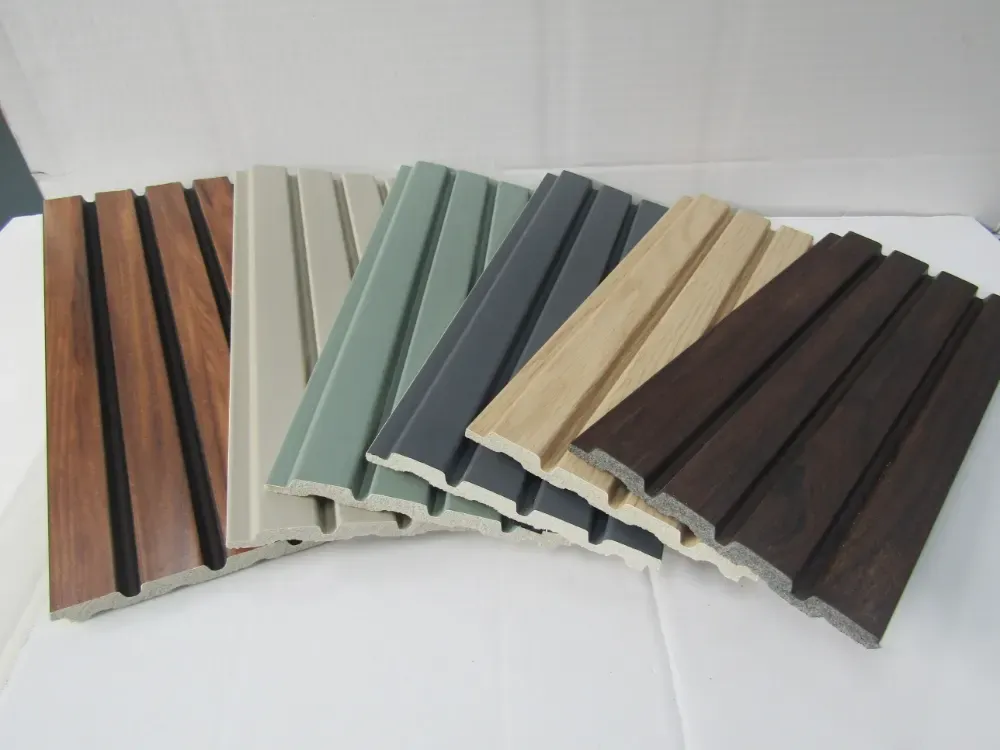
The models covered here use six widths: 120mm on DC12012, 153mm on DC15318, 200mm on DC20012, 247mm on DC24719, 250mm on DC25018, and 300mm on DC30006 and the D3003 series. Each of these models pairs its width with a fixed thickness, so the list is a list of profiles rather than a list of widths you can recombine.
A worked example on a 3.0m wall
Take a wall 3.0m wide and 2.8m high, with the panels running vertically, which is the orientation this arithmetic assumes. Height is covered by one panel length, so width decides the count. Dividing 3000mm by each width gives 25 panels at 120mm, 20 at 153mm, 15 at 200mm, 13 at 247mm, 12 at 250mm, and 10 at 300mm.
Two of those figures are rounded up, and the rounding is worth understanding. At 153mm, 19 full panels cover 2907mm and leave 93mm. At 247mm, 12 full panels cover 2964mm and leave 36mm. A 36mm strip is not a sensible panel, so the layout is normally adjusted instead of cut: the run is set out slightly differently at the ends, or the installer takes up the difference with the edge finish they are using. Allow for that before you fix the quantity.
Seams follow the same arithmetic. If panels are butted side to side across the wall, ten panels create nine internal seams and twenty-five create twenty-four. A narrower profile does not hide this; it multiplies it, and more seams mean more joints to align and finish.
Choosing a profile is not only a question of how it looks on a sample. It is a question of how many times the same operation is repeated across the wall.
Width and thickness arrive as a pair
The six models pair their widths with fixed thicknesses: DC12012 is 120mm by 12mm, DC15318 is 153mm by 18mm, DC20012 is 200mm by 12mm, DC24719 is 247mm by 19mm, DC25018 is 250mm by 18mm, and DC30006 is 300mm by 6mm. The D3003 series also runs at 300mm, at 3mm. Thickness is the profile depth, measured from the back of the panel to the top of the flute.
That pairing is why the width choice is also a surface choice. If you want a different depth at the same width, it is a different model rather than an option on the same one. Among the models listed here, 300mm is the one width that appears in two depths: 6mm on DC30006 and 3mm on the D3003 series.
Length decides whether a wall is one length or two
Panels come at 2.9m as standard, and 2.8m or 2.4m can be produced where a project needs it. In the example above, a 2.8m ceiling is covered by a single 2.9m panel, trimmed by 100mm, so one length per vertical run is enough. On a wall taller than the panel length, every vertical run needs two lengths and the quantity roughly doubles.
Check the ceiling height against the panel length before fixing the width. A room that is slightly over a standard length turns a single-length order into a two-length one, and that changes both the quantity and the loading plan.
What to put in the enquiry
Send the model code with its sub-series letter where one applies, the wall width and height in millimetres, the panel length you need, and the exact colour code. With those four items the panel count and the box count can be worked out in one pass, using the packing quantity for that model. Price and lead time are confirmed at quotation for the specific order.
If you are comparing two or three widths for the same wall, send the wall dimensions through our contact page and we will work out the panel count for each option side by side.